Margaret Hamilton and the Software That Saved Apollo
The remarkable story of Margaret Hamilton — how a mathematician from Indiana led the team that wrote the Apollo Guidance Computer software, invented the discipline of software engineering, and saved the Moon landing.
Before She Reached for the Moon
Margaret Heafield was born on August 17, 1936, in Paoli, Indiana — a small town of a few thousand people in the rolling hills of southern Indiana. She was the daughter of a schoolteacher and a poet-philosopher, and from an early age she displayed an unusual aptitude for mathematics and abstract thinking.
She earned her bachelor's degree in mathematics with a minor in philosophy from Earlham College in 1958. That same year, she married James Hamilton and moved to Boston, where her husband enrolled in Harvard Law School. Margaret planned to pursue a graduate degree in abstract mathematics at Brandeis University. But first, she took what she expected to be a temporary job — a job that would change the history of computing and space exploration.
Joining MIT
In 1959, Margaret Hamilton joined the MIT Meteorology Department, where she worked on software for Professor Edward Lorenz — the same Edward Lorenz who would later become famous for chaos theory and the "butterfly effect." Hamilton wrote code for Lorenz's weather prediction programs, running on the LGP-30 computer. It was here that she first discovered her talent for programming and her fascination with the behavior of complex software systems.
In 1961, she moved to MIT's Lincoln Laboratory, where she worked on the Semi-Automatic Ground Environment (SAGE) air defense system — one of the largest and most complex computer systems of the Cold War era. The SAGE project gave Hamilton experience with real-time computing, fault tolerance, and the challenges of software that could not afford to fail. These skills would prove essential for what came next.
In 1963, Hamilton joined the MIT Instrumentation Laboratory (later renamed the Charles Stark Draper Laboratory), which had been awarded the contract to develop the guidance and navigation system for the Apollo spacecraft. She was initially hired to work on software for the unmanned missions that would precede the crewed flights.
Her talent was immediately apparent. Within months, she was leading the development of the onboard flight software for the Apollo Guidance Computer. By the mid-1960s, she was the director of the Software Engineering Division at the Instrumentation Laboratory, overseeing a team that would eventually grow to over 400 engineers and programmers.
She was in her late twenties. She had a young daughter, Lauren. And she was responsible for writing the software that would take human beings to the Moon.
Building the AGC Software
The challenge was unprecedented. No one had ever written software for a real-time, mission-critical spacecraft computer. There were no textbooks, no established methodologies, no prior art to draw on. Hamilton and her team had to invent everything from scratch — the programming techniques, the testing methods, the error-handling strategies, and the very concept of what reliable software should look like.
The AGC software was written in a custom assembly language called AGC Assembly (sometimes called "AGC4" for the Block II computer). Every instruction had to be hand-coded and hand-verified. The entire program — encompassing navigation, guidance, autopilot, display management, and the operating system — had to fit within the 36,864 words (approximately 74 kilobytes) of core rope memory.
Hamilton structured the software around several key innovations:
The Executive. At the heart of the AGC software was a priority-based multitasking system that Hamilton's team called the Executive. Unlike conventional programs that ran sequentially, the Executive could manage multiple "jobs" running concurrently, each assigned a priority level from 0 (lowest) to 7 (highest). When computer resources were scarce, the Executive would preempt lower-priority jobs to ensure higher-priority jobs — such as guidance and navigation — continued uninterrupted.
The Waitlist. Complementing the Executive was the Waitlist, a timer-driven task scheduler. Programs could request that a task be executed after a specified delay. The Waitlist managed these deferred tasks efficiently, allowing the AGC to handle complex sequences of time-dependent operations without dedicating processing power to idle waiting.
The Restart Protection System. Hamilton's team designed the software so that it could recover from hardware faults and restart cleanly. If the AGC detected an error severe enough to require a restart, the Restart Protection System ensured that critical variables were preserved and that the computer could resume operations from a known good state — rather than losing everything and starting over.
The Interpreter. The AGC's native instruction set was limited to basic operations. To handle the complex mathematical computations required for navigation — trigonometric functions, vector operations, matrix transformations — Hamilton's team built a software-based virtual machine called the Interpreter. This effectively doubled the AGC's instruction set, allowing elegant expression of guidance equations while keeping the hardware simple and reliable.
The Famous Stack of Code
One of the most iconic photographs in the history of computing shows Margaret Hamilton standing next to a stack of printed program listings that reaches from the floor to above her head. The printouts contain the source code for the AGC software — the complete Colossus (Command Module) and Luminary (Lunar Module) programs.
The image is striking not just for its visual drama, but for what it represents: every line of that code was written, tested, and verified by Hamilton's team. Every subroutine, every error-handling branch, every numerical constant was placed there by human effort. The stack of paper is the physical manifestation of years of intellectual labor by hundreds of people, distilled into a program that would run on a computer with less memory than a modern kitchen timer.
"That Will Never Happen"
Hamilton was a tireless advocate for software robustness. She pushed her team to consider every possible failure mode — not just the ones that seemed likely, but the ones that seemed impossible. She called this approach "ultra-reliability."
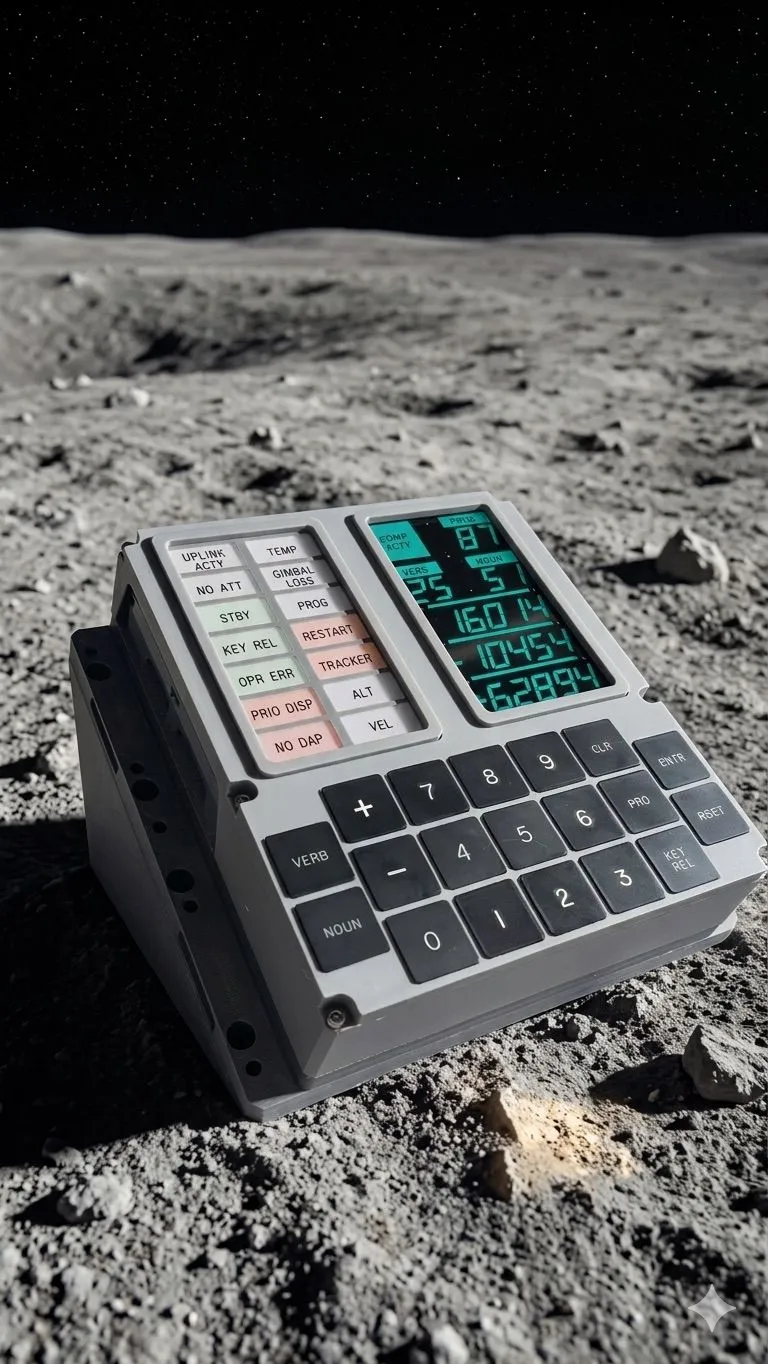
One story illustrates her philosophy perfectly. During development, Hamilton's young daughter Lauren was playing with the DSKY simulator at the lab. Lauren pressed keys in a sequence that launched Program 01 (P01) — the prelaunch initialization program — during a simulated mid-flight scenario. The result was a catastrophic software crash: P01 wiped out the navigation data stored in erasable memory.
Hamilton immediately recognized the danger. If an astronaut accidentally selected P01 during flight, the same thing would happen — and with real consequences. She requested that a safeguard be added to prevent P01 from being selected during flight.
NASA's response was that astronauts were trained professionals who would never make such a mistake. "That will never happen," they told her.
Hamilton was not satisfied. She added a program note to the documentation warning of the danger. Sure enough, on Apollo 8 — the first crewed mission to orbit the Moon — astronaut Jim Lovell accidentally selected P01 during flight, wiping out the navigation data. The crew had to spend hours realigning the guidance platform using star sightings. After that incident, NASA approved Hamilton's safeguard, and it was added to the software for subsequent missions.
The episode reinforced Hamilton's conviction that software must be designed to protect users from their own errors — a principle that is now fundamental to every well-designed software system.
The 1202 Alarm: Vindication
The ultimate test of Hamilton's software philosophy came on July 20, 1969, during the Apollo 11 lunar landing. As Eagle descended toward the Moon, the DSKY displayed a 1202 program alarm — the Executive had detected that the computer was overloaded with tasks.
The overload was caused by the rendezvous radar feeding unnecessary data to the AGC during the descent. Under a conventional software design, this overload would have crashed the computer, forcing an abort of the landing.
But Hamilton's priority-based Executive worked exactly as designed. It detected the overload, discarded the lower-priority tasks (including the radar data processing), and continued running the critical guidance computations without interruption. The software did not crash. It did not lose data. It made an intelligent decision about what mattered most and kept doing it.
Steve Bales, the guidance officer in Mission Control, confirmed: "We're Go on that alarm." The landing continued. Armstrong and Aldrin walked on the Moon.
Hamilton later reflected: "If the computer hadn't recognized this problem and taken recovery action, I doubt if Apollo 11 would have been the successful Moon landing it was." The 1202 alarm became the most famous validation of fault-tolerant software design in history.
Coining "Software Engineering"
During the Apollo project, Hamilton began using the term "software engineering" to describe her team's work. At the time, software development was not considered a legitimate engineering discipline. Hardware engineers and mathematicians looked down on programming as a lesser activity — something akin to clerical work.
Hamilton chose the term deliberately to elevate the status of software development and to argue that it deserved the same rigor, discipline, and respect as traditional engineering fields. She wanted to establish that building reliable software required systematic methods, formal verification, and professional accountability — just like building bridges or aircraft.
The term was initially met with amusement and even ridicule. "They used to kid me about my radical ideas," Hamilton recalled. "Software engineering — they would say — what's that?"
Today, software engineering is one of the most important and respected professions in the world. The discipline that Hamilton named now employs tens of millions of people globally and underpins virtually every aspect of modern civilization. The term she coined in the 1960s is used billions of times a year.
After Apollo
After the Apollo program, Hamilton founded two companies: Higher Order Software (HOS) in 1976 and Hamilton Technologies, Inc. (HTI) in 1986. At both companies, she continued to develop and refine her ideas about software reliability, error prevention, and systems design.
At HOS, she developed a methodology called the Higher Order Software Specification Language, which used mathematical proofs to verify software correctness before coding began. At HTI, she created the Universal Systems Language (USL) and the Development Before the Fact (DBTF) paradigm — a systems engineering approach that aims to prevent errors from entering the development process in the first place, rather than testing for them after the fact.
Her work has influenced generations of software engineers, particularly in safety-critical fields such as aviation, medical devices, and autonomous vehicles.
Honors and Recognition
For decades, Hamilton's contributions were not widely recognized outside the aerospace community. The culture of the 1960s and 1970s often minimized the contributions of women in technical fields, and the role of software in the Apollo program was frequently overshadowed by the more visible achievements of the astronauts and the rocket engineers.
That began to change in the 2000s, as the history of computing received greater attention and the importance of software in the Apollo program became better understood. Hamilton's contributions were finally recognized with some of the highest honors:
- 2003: NASA awarded Hamilton the Exceptional Space Act Award — the largest financial award NASA had ever given to an individual at the time — for the mathematical and scientific contributions of her Apollo flight software
- 2009: She received the Outstanding Alumni Award from Earlham College
- 2016: President Barack Obama awarded Hamilton the Presidential Medal of Freedom — the highest civilian honor in the United States — recognizing her as a pioneer of software engineering whose work was essential to the success of the Apollo missions
- 2017: A LEGO minifigure of Hamilton was released as part of the "Women of NASA" set, introducing her story to a new generation
- 2019: On the 50th anniversary of the Apollo 11 landing, Hamilton was widely celebrated in media coverage around the world
Legacy
Margaret Hamilton's legacy extends far beyond the Apollo program. She did not merely write software that flew to the Moon — she established the intellectual framework for how reliable software should be designed, built, and managed.
Her key contributions to the field include:
- Priority-based error recovery — the principle that software should gracefully handle overload by shedding non-essential tasks
- Asynchronous software architecture — designing systems that can manage multiple concurrent processes safely
- End-to-end testing methodologies — verifying software behavior across all possible inputs and states
- Human-error prevention — designing software to protect users from dangerous mistakes
- The concept of software engineering as a discipline — elevating software development from an ad-hoc activity to a rigorous profession
Every time a computer operating system recovers from an error without crashing, every time a real-time control system handles an unexpected input gracefully, every time an autopilot maintains control despite a sensor failure — that is Margaret Hamilton's legacy at work.
At apolloreplica.com, the DSKY replicas we build run software inspired by the same principles Hamilton established. The priority executive, the Verb-Noun interface, the alarm system — these are not just historical curiosities. They are the foundational concepts of modern software engineering, born in a lab at MIT, proven 240,000 miles from Earth, and carried forward by every software engineer who has followed in Margaret Hamilton's extraordinary footsteps.