The Apollo Guidance Computer — History & Technology
A comprehensive guide to the Apollo Guidance Computer — from its development at MIT to its role in every mission phase. Covering architecture, specifications, integrated circuits, software, and the lasting legacy of the machine that navigated humanity to the Moon.
The Computer That Navigated to the Moon
On July 20, 1969, when Neil Armstrong guided the Lunar Module Eagle to the surface of the Moon, the machine doing the critical navigation calculations was smaller than a modern laptop, weighed 70 pounds, and had less computing power than a basic pocket calculator. Yet the Apollo Guidance Computer (AGC) accomplished what no computer before or since has done in quite the same way: it navigated human beings to another world in real time, with zero margin for error.
The AGC was not just a computer. It was a revolution in miniaturized electronics, a proving ground for integrated circuits, a landmark in software engineering, and the direct ancestor of the embedded computers that now permeate every aspect of modern life. This is the story of its creation, its technology, and its enduring legacy.
Origins: MIT and the Instrumentation Laboratory
The story of the AGC begins in 1961, when NASA awarded a contract to the MIT Instrumentation Laboratory (MIT IL) to develop the guidance and navigation system for the Apollo spacecraft. The laboratory, founded and led by Dr. Charles Stark Draper — the "father of inertial navigation" — had a long history of building precision guidance systems for military applications.
Draper appointed a team led by Eldon Hall as chief hardware architect and Ramon Alonso as lead logic designer. The software effort would eventually be led by Margaret Hamilton. The initial challenge was daunting: design a computer small enough, light enough, and reliable enough to fly aboard a spacecraft, yet powerful enough to handle real-time navigation, guidance, and control for a mission to the Moon.
In 1961, no such computer existed. The most powerful computers of the era filled entire rooms and weighed tons. The idea of a flyable, real-time guidance computer was at the very edge of what technology could achieve.
Block I and Block II
The AGC went through two major design iterations:
Block I was the initial design, developed from 1961 to 1965. It used approximately 4,100 integrated circuits (ICs) of a single type — the three-input NOR gate — along with a small number of sense amplifiers and other support circuits. Block I had 12,288 words of fixed (read-only) memory and 1,024 words of erasable (read-write) memory. It flew on unmanned test missions and the early Apollo flights.
Block II was the refined design that flew on all crewed Apollo missions from Apollo 7 onward. It represented a significant upgrade:
- Fixed memory was tripled to 36,864 words (approximately 74 KB)
- Erasable memory was doubled to 2,048 words (approximately 4 KB)
- The instruction set was expanded and optimized
- The interface to spacecraft systems was enhanced
- Overall reliability was improved
Block II used approximately 5,600 NOR gate ICs — the most integrated circuits in any computer at that time. Each IC contained two three-input NOR gates, and remarkably, the entire computer was built from this single type of logic gate. By combining NOR gates in different configurations, the designers could create any Boolean logic function: AND, OR, NOT, NAND, flip-flops, registers, and all other digital logic required.
Architecture
The Block II AGC was a 15-bit, single-address computer with a fixed word length. Its architecture was remarkably clean and efficient for its time:
Central Processor: - 15-bit word length (plus one parity bit) - Single accumulator architecture - Hardware multiply instruction (a significant advancement) - 11 basic instructions in the standard instruction set - The Interpreter software extended this to dozens of "pseudo-instructions"
Memory System: - Fixed memory (ROM): 36,864 words in core rope memory — physically woven, non-volatile, and radiation-hardened - Erasable memory (RAM): 2,048 words in magnetic core memory — read-write, non-volatile (data preserved through power cycles) - Memory cycle time: 11.72 microseconds (one machine cycle)
Clock and Timing: - Master clock: 2.048 MHz - Machine cycle: 11.72 microseconds (approximately 85,000 cycles per second) - Each instruction took 1 or 2 machine cycles to execute, yielding an effective speed of roughly 40,000 to 85,000 instructions per second
Input/Output: - Digital interface to the Inertial Measurement Unit (IMU) - DSKY (Display and Keyboard) interface - Uplink and downlink telemetry interfaces - Engine control interfaces (descent engine, ascent engine, reaction control thrusters) - Optics and rendezvous radar interfaces - Hand controller interfaces for manual spacecraft control
Power Consumption: - Approximately 70 watts — roughly the same as a modern incandescent light bulb - Operated from the spacecraft's 28-volt DC power bus
Physical Specifications: - Dimensions: 24 × 12.5 × 6.5 inches (61 × 32 × 17 cm) - Weight: approximately 70 pounds (32 kg) - The complete system (AGC + DSKY + interface electronics) weighed about 150 pounds (68 kg)
The Integrated Circuit Revolution
The AGC holds a unique place in the history of electronics: it was the first mass application of integrated circuits. When MIT began designing the AGC in 1962, ICs were a brand-new technology. Fairchild Semiconductor had introduced the first practical ICs only a few years earlier, and they were expensive, unreliable, and unproven.
Most aerospace engineers at the time preferred tried-and-tested discrete transistor circuits. The decision to use ICs in the AGC was considered risky — even reckless by some. But Eldon Hall and his team recognized that ICs offered the only realistic path to building a computer small and light enough for spaceflight.
The AGC's demand for ICs had a transformative effect on the semiconductor industry. At the peak of Apollo procurement, NASA was purchasing 60% of all integrated circuits manufactured in the United States. This enormous demand:
- Drove down IC prices from over $1,000 per chip in 1961 to under $25 by the late 1960s
- Forced manufacturers to improve quality and reliability dramatically
- Funded the development of better manufacturing processes
- Created economies of scale that made ICs viable for commercial applications
Without Apollo, the integrated circuit revolution might have been delayed by years or even decades. The computer in your pocket exists, in a very real sense, because NASA needed a computer that could fly to the Moon.
The specific IC used in the AGC was the Fairchild Micrologic series — a flat-pack, resistor-transistor logic (RTL) chip containing two three-input NOR gates. Each chip measured roughly 0.5 × 0.25 inches. The 5,600 chips in the Block II AGC were mounted on "trays" of interconnected circuit boards, with gold wire-bonded connections.
The Software: Luminary and Colossus
The AGC hardware was only half the story. The software that ran on it was equally revolutionary — arguably more so.
Two major software packages were developed:
Colossus was the Command Module software, responsible for navigation between Earth and the Moon, translunar and transearth trajectory management, entry guidance through Earth's atmosphere, and rendezvous calculations.
Luminary was the Lunar Module software, responsible for lunar descent guidance, powered ascent, rendezvous with the Command Module, and abort computations.
Both were written in AGC Assembly — a custom assembly language with mnemonics like TC (transfer control), CA (clear and add), and TS (transfer to storage). The programs were structured around the Executive and Waitlist operating system designed by Margaret Hamilton's team.
Key software components included:
The Executive: A priority-based task scheduler that managed up to eight concurrent "jobs." Each job was assigned a priority from 0 to 7. When conflicts arose, higher-priority jobs preempted lower-priority ones. This design was critical during the Apollo 11 landing, when the Executive shed lower-priority radar tasks to keep the guidance calculations running despite a computer overload.
The Waitlist: A timer-driven scheduler for deferred tasks. Programs could schedule a task to execute after a specified interval, allowing efficient management of time-sequenced operations.
The Interpreter: A software virtual machine that extended the AGC's basic 11-instruction set with advanced operations including double-precision arithmetic, trigonometric functions, vector and matrix mathematics, and coordinate transformations. The Interpreter allowed navigation equations to be expressed concisely, saving precious memory.
The Digital Autopilot (DAP): Software that controlled the spacecraft's attitude using reaction control thrusters or the descent engine gimbal. The DAP ran continuously as a background task, making thousands of small corrections per hour to maintain the desired spacecraft orientation.
The Noun-Verb Interface: The software layer that managed the DSKY display and keyboard, translating Verb-Noun codes into computer operations and formatting numeric data for the astronaut displays.
The complete Luminary program (for the Apollo 11 Lunar Module) contained approximately 36,000 words of code. The complete source code was meticulously documented and has been preserved — it was made publicly available on GitHub in 2016, where it quickly became one of the most-starred repositories in history.
Role in Each Mission Phase
The AGC was not a passive navigator. It was actively involved in every phase of an Apollo mission:
Launch and Earth Orbit: During the Saturn V launch, the AGC in the Command Module monitored the booster's performance and stood ready to initiate an abort if parameters exceeded safe limits. After orbital insertion, the AGC calculated the spacecraft's orbit and planned the Translunar Injection (TLI) burn.
Translunar Coast: During the three-day journey to the Moon, the AGC continuously updated the spacecraft's position and velocity using star sightings (taken through the sextant and telescope by the astronaut) and ground-based tracking data uplinked from Mission Control. It computed midcourse correction burns to keep the trajectory on target.
Lunar Orbit Insertion (LOI): The AGC calculated and monitored the engine burn that placed the spacecraft into lunar orbit. This was one of the most critical maneuvers — the burn had to be precisely timed and vectored while the spacecraft was behind the Moon, out of contact with Earth.
Powered Descent: After the Lunar Module separated, its AGC took over, running the guidance programs that controlled the descent engine from 50,000 feet to the lunar surface. The descent was divided into phases — braking (P63), approach (P64), and landing (P66) — each controlled by a different software program. The AGC automatically managed the throttle, attitude, and trajectory while displaying critical data to the astronaut on the DSKY.
Lunar Surface Operations: While on the Moon, the AGC in the LM calculated the launch window for ascent and maintained the inertial reference platform. The AGC in the orbiting Command Module tracked the spacecraft's orbit and prepared rendezvous calculations.
Powered Ascent: The LM's AGC guided the ascent engine burn to place the LM into an orbit that would intersect with the Command Module. The ascent had to be precisely timed and guided — there was only enough fuel for one attempt.
Rendezvous and Docking: Both AGCs worked together during the rendezvous sequence. The LM's computer calculated the intercept trajectory, while the CM's computer tracked the LM's position using rendezvous radar. The astronauts monitored both computers' solutions and could switch to manual control if the calculations diverged.
Transearth Coast and Entry: After the crew transferred back to the Command Module, its AGC guided the spacecraft home. The most demanding phase was atmospheric entry — the AGC guided the Command Module through a narrow entry corridor at over 24,000 miles per hour, managing the spacecraft's lift vector to control the deceleration forces and achieve the targeted splashdown point.
Reliability
The AGC achieved an extraordinary reliability record. Across all Apollo missions, there was never a hardware failure of the AGC that jeopardized a mission. The computer operated in the vacuum of space, endured temperature extremes from direct sunlight to shadow, survived the violent vibrations of launch, and functioned flawlessly through radiation exposure that would damage modern consumer electronics.
This reliability was achieved through several design strategies:
- Conservative IC utilization: Each NOR gate IC was operated well below its rated limits, providing wide safety margins
- Triple-redundant power supplies: The AGC had three independent power regulators
- Parity checking: Every memory word included a parity bit for single-bit error detection
- Software restart protection: The software could recover from transient hardware faults without losing critical data
- Extensive testing: Every AGC unit underwent thousands of hours of testing before flight qualification
Legacy
The Apollo Guidance Computer's legacy extends far beyond the Apollo program:
Embedded computing. The AGC was the first major embedded computer — a computer built into a larger system (the spacecraft) to perform a specific function. Today, embedded computers are everywhere: in cars, aircraft, medical devices, appliances, phones, and billions of IoT devices. The AGC established the concept.
Integrated circuit industry. Apollo's massive IC purchases created the market conditions that allowed the semiconductor industry to achieve economies of scale, driving the prices down and the quality up to the point where ICs became commercially viable. The path from the AGC's Fairchild NOR gates to the billions of transistors in a modern smartphone processor is direct and unbroken.
Real-time operating systems. The Executive and Waitlist were among the first real-time operating systems ever built. Their principles — priority scheduling, preemptive multitasking, timer-driven task management — are the foundation of every RTOS in use today, from automotive engine controllers to Mars rovers.
Software engineering. The AGC project forced the creation of systematic software development practices. Margaret Hamilton's team pioneered concepts including formal testing, error recovery, priority-based fault tolerance, and end-to-end system verification. These practices became the foundation of software engineering as a discipline.
Human-computer interaction. The DSKY's Verb-Noun interface was one of the first real-time, safety-critical human-computer interfaces. Its design principles — minimal keystrokes, clear feedback, error tolerance, mode indication — remain central to HCI design.
The AGC Today
The complete AGC hardware and software designs are now in the public domain. Enthusiasts and historians have built working replicas using both original-style discrete logic and modern FPGAs. The Luminary and Colossus source code is available on GitHub, exhaustively commented and annotated.
Several original AGC units survive in museums:
- The Smithsonian National Air and Space Museum in Washington, D.C., displays AGC units from multiple Apollo missions
- The Computer History Museum in Mountain View, California, has a restored and operational AGC
- The MIT Museum in Cambridge, Massachusetts, holds archival materials from the AGC development
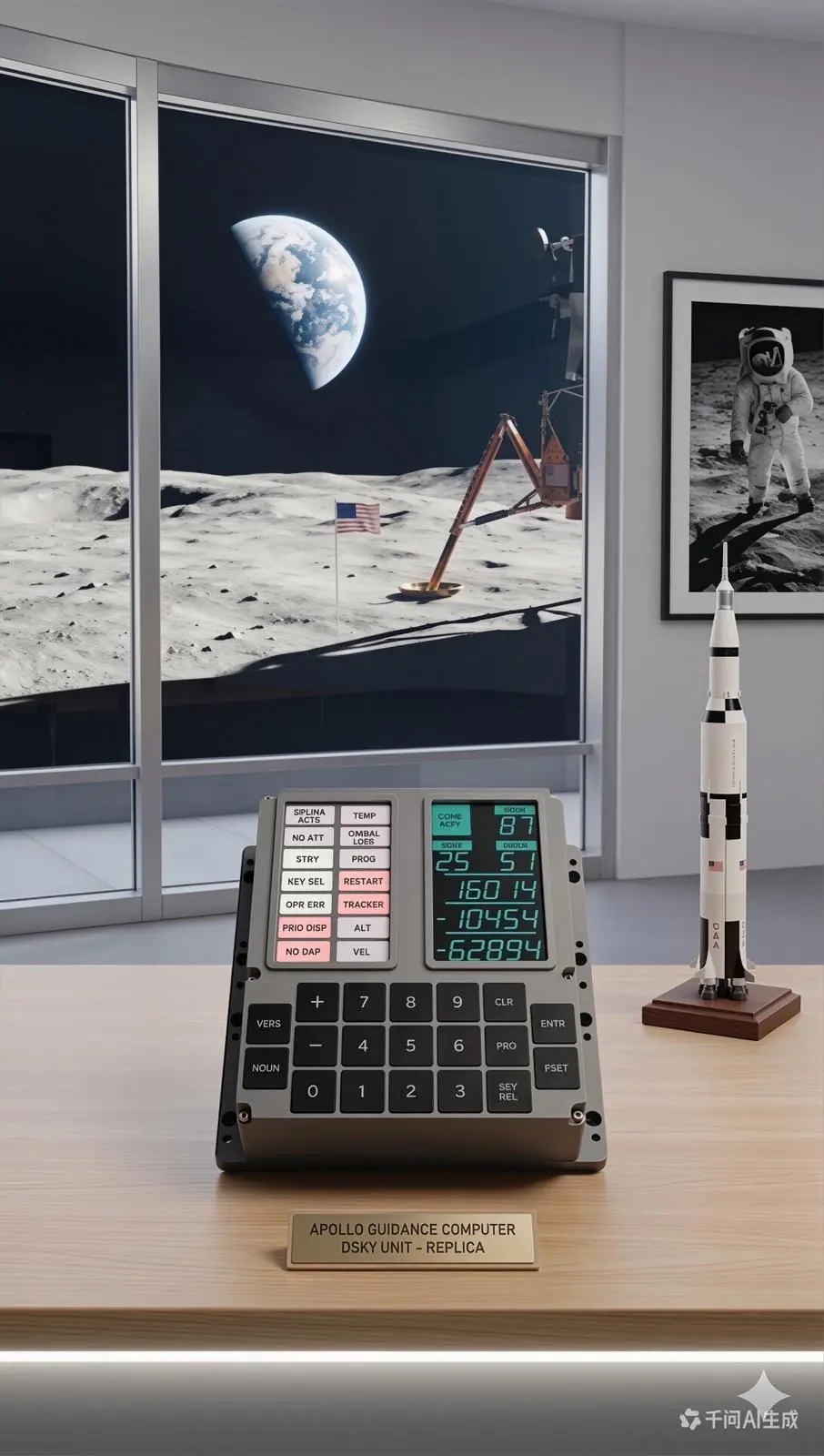
At apolloreplica.com, our DSKY replicas honor the AGC's legacy by faithfully reproducing the display and keyboard interface that connected astronauts to this remarkable machine. When you type a Verb-Noun code and see the electroluminescent-style digits respond, you are experiencing the same interface that guided twelve human beings to the surface of the Moon — the interface of the most consequential computer ever built.
The AGC proved that a small, reliable, well-programmed computer could accomplish tasks that many believed were beyond the reach of any machine. In doing so, it did not just take humanity to the Moon. It showed us what computers could become — and in that vision, our entire digital world was born.